
Do Maltese homes need a well? The cistern rule
Since June 2016, new developments in Malta and Gozo must include a rainwater reservoir sized in line with Technical Document F and connected to a pump. Here is what the rule covers, what the plumber has to connect, and why WSC's New Water is not a substitute.
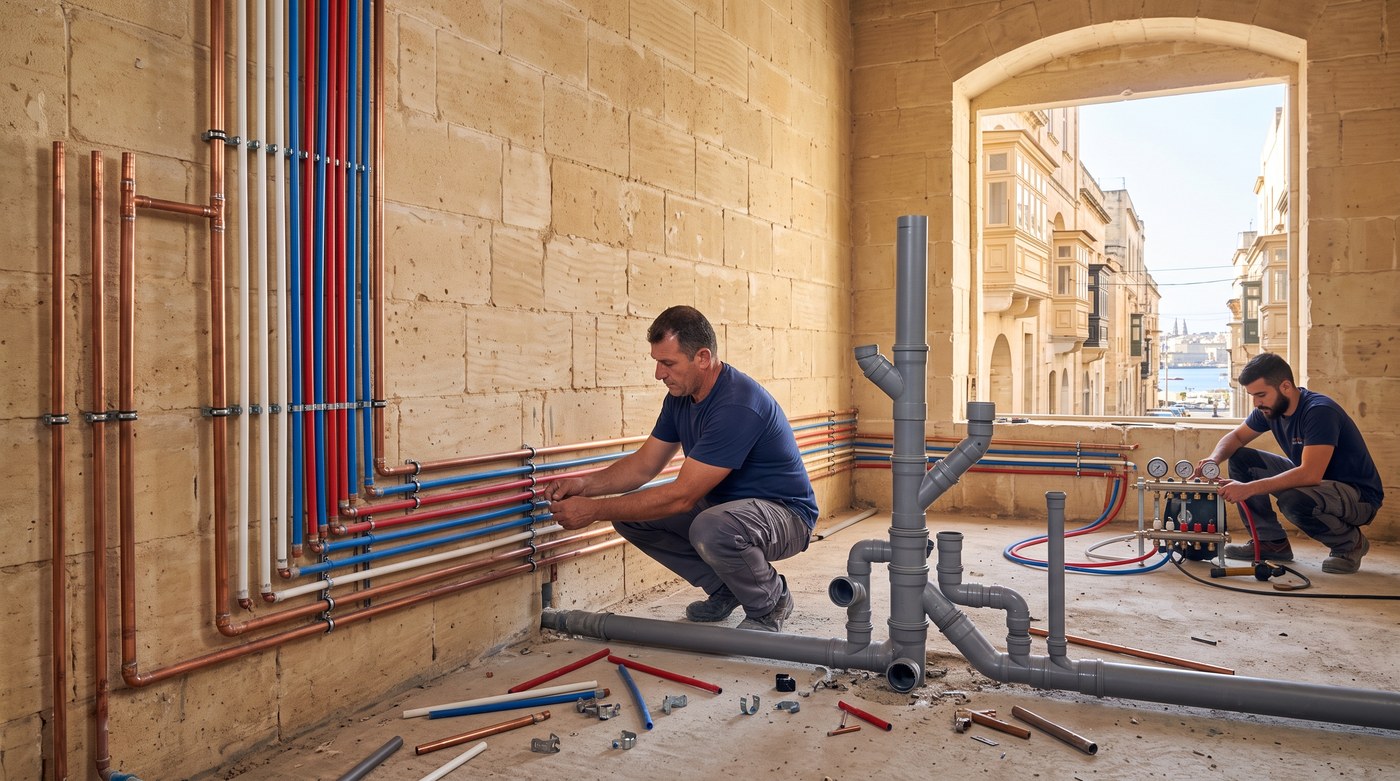
Buyers arriving from the UK usually have a mental model of water that does not survive contact with a Maltese property. There is no water company with a regional monopoly and a combi boiler on every wall; there is the Water Services Corporation, a roof tank, an electric geyser, and — under the house — a hole in the rock that the vendor may or may not mention.
That hole is not folklore. Since 2016 it has been a condition of building.
What the rule actually says
The Development Planning (Health and Sanitary) Regulations, subsidiary legislation 552.22, were brought in by Legal Notice 227 of 2016 and came into force on 10 June 2016. They replaced the sanitary rules that had governed Maltese building for decades.
Regulation 10(1) is the one that matters here. In substance it requires that a new development be provided with a reservoir for the collection of rainwater, with the capacity of that reservoir determined in accordance with Technical Document F, and that the reservoir be connected to a pump.
Two separate obligations, then. A volume of storage, and a means of getting the water back out and into the building. A cistern with no pump and no pipework is not compliance; it is a hole.
The Planning Authority announced the overhaul as part of a broader sanitary rewrite, and the pump connection was flagged at the time as part of the requirement rather than an optional extra. Enforcement sits with the planning process and with the Environmental Health Directorate.
Well, cistern, reservoir, bir
All the same object. Maltese houses have collected roof runoff into an excavated rock chamber for centuries, because the islands have no rivers and rainfall arrives in a few violent months. The regulation calls it a reservoir. Estate agents call it a well. Older Maltese vendors will say bir. When a listing says "with well", it means this — not a borehole into the aquifer, which is a different thing entirely and not what Regulation 10 is about.
Sizing: Technical Document F does the arithmetic
The legal notice does not itself print a capacity. It points at Technical Document F, one of the technical documents that sit under Maltese building regulation, and makes that document's method the measure of whether your reservoir is big enough.
This is the honest limit of what can be said here: the sources used for this article do not reproduce the numbers in Technical Document F. Any figure quoted to you in litres per square metre of roof, or cubic metres per bedroom, should come from your architect (perit) working from the document itself, not from a plumber, a forum post, or this page. The perit sizes it; it appears on the sanitary drawings that go in with the application.
What this means if you are buying shell form
Most new property in Malta and Gozo changes hands in shell form — bare blockwork, no screed, no finishes, frequently no first fix. The permit and the sanitary drawings belong to the development; the reservoir is therefore the developer's obligation and should already exist beneath the building before you ever see it.
What is very often not done at handover is the second half of Regulation 10: the pump and the pipework off it. You inherit an excavated chamber with a manhole cover and nothing connected. Completing that is finishing work, and it is yours.
So when you view a shell, ask three things and get them in writing:
- Where is the reservoir, and what capacity does the approved drawing show?
- Are the downpipes from the roof and yards actually discharging into it, or are they still running to the street?
- Is there a pump chamber, a power point near it, and a dedicated rising main stubbed out — or is that all still to be first-fixed?
Question two catches more people than you would expect. A reservoir that nothing drains into stays empty.
Apartments and the condominium
In a block, the reservoir is almost always common property. The pump, the rising main and the meter arrangements sit in the common parts, which means anything you want to do to them is condominium business, not your business alone. If you are the only owner who wants a second-class supply to your WCs, you are asking for a change to shared plant and you need the condominium's agreement before anyone drills anything. Get that settled before you commission the work, not after the pump is on the floor.
What the plumber connects
The regulation, as sourced, gives the plumber one hard instruction: the reservoir is connected to a pump. Everything downstream is design.
In normal Maltese practice the pump feeds a second-class supply — a pipe network kept physically separate from the potable one, usually serving:
- WC cisterns, which are the largest single non-drinking demand in a house
- an outside tap, roof washing point or irrigation line
- sometimes a washing machine point
Separation is the whole discipline of the job. Second-class pipework should be distinguishable, and it must not be able to feed back into the drinking supply. The sources quoted here do not specify backflow devices, break tanks, pipe colours or labelling, so treat those as matters for your perit and installer against the technical documents rather than as things this article has established.
One practical note peculiar to the islands: mains pressure into many properties is low and the house is fed from a roof tank, so a household can end up with three water systems running at once — mains to tank, tank to taps and geyser, and cistern to pump to second-class. Whoever does your first fix needs to know which is which before the screed goes down. In Gozo, factor in that pumps, tanks and fittings arrive by ferry, so a wrong specification is a delay measured in days rather than hours.
Why New Water is not the answer
Readers sometimes hear about New Water and assume it is a cheap second-class mains they can ask to be connected to. It is not.
New Water is the Water Services Corporation's polished treated effluent. It is distributed through dispensers and is directed at registered farmers. It is not piped to households and it is not a domestic product. There is no version of this where the WSC brings a purple pipe to your door instead of you building a reservoir.
That is precisely why Regulation 10 exists. On an island with no surface water, the policy answer to non-potable household demand is that each new building stores its own rain.
The short version
If you are building or buying new, the reservoir is not optional and neither is the pump. Check the approved drawings for capacity, check that the roof actually drains into the thing, and treat the pump and second-class pipework as work that has to be specified, priced and separated from the drinking supply — by someone who understands that a Maltese house has more than one water system in it.
Common questions
- Is a rainwater well actually compulsory in Malta, or is it just traditional?
- It is a legal requirement for new development. Regulation 10 of the Development Planning (Health and Sanitary) Regulations, S.L. 552.22, brought in by LN 227 of 2016 and in force from 10 June 2016, requires a new development to be provided with a rainwater reservoir with its capacity determined in line with Technical Document F, and requires that reservoir to be connected to a pump. It is enforced through the planning process and by the Environmental Health Directorate.
- My flat is in a block built in the 1990s with no well. Do I have to dig one?
- The regulations that came into force in June 2016 are framed around new development. The sources used for this article do not establish any retrofit obligation on an existing building that already has its permits and was built before the rule, and they do not set out how the requirement is applied to alterations to an existing block. If you are buying, ask the vendor's architect what the sanitary drawings for that permit actually show rather than assuming either way.
- Can I just use WSC's New Water instead of a cistern?
- No. New Water is polished treated effluent distributed by the Water Services Corporation through dispensers to registered farmers. It is not a mains product piped into homes, so it is not an alternative to your own rainwater reservoir for domestic second-class use.
- What does the plumber have to connect to the cistern?
- The regulation as sourced requires the reservoir to be connected to a pump. In ordinary practice that pump feeds a second-class supply — typically WC cisterns, an outside tap or irrigation, and sometimes a washing machine point — kept entirely separate from the potable supply. Which outlets are served is a design decision; the sources quoted here establish the reservoir and the pump, not a fixture list.
What we could not establish
- The actual sizing figures in Technical Document F — litres of reservoir per square metre of roof, per dwelling, or per bedroom — are not reproduced in any of the sources used here, so no capacity number is quoted in this article.
- The sources establish that the reservoir must be connected to a pump, but they do not prescribe which fixtures the second-class supply must serve, nor pump type, nor whether a break tank or backflow device is specified.
- No source used here states how the requirement is applied to a change of use, a full internal conversion of an existing building, or the addition of floors to an existing block.
- Penalties for non-compliance, and whether a missing or infilled reservoir is picked up at compliance certificate stage, are not established by these sources.
- Nothing in these sources addresses rainwater quality, filtration, first-flush arrangements or whether stored rainwater may be treated for potable use.
- The sources do not name a qualification, licence or register that the person installing the pump and second-class pipework must hold.
Sources
- Development Planning (Health and Sanitary) Regulations – S.L. 552.22 (LN 227 of 2016) — Government of Malta (iAS copy) · read 2026-09-21
- New health and sanitary regulations in buildings come into force — The Malta Independent · read 2026-09-21
- New houses require water reservoir, PA announces in sanitary overhaul — MaltaToday · read 2026-09-21
- New Water – Water Services Corporation — Water Services Corporation · read 2026-09-21
Want this costed properly?
The calculator gives you a figure in a minute. A site visit gives you a fixed price.
Book a free survey