
How to choose a plumber in Malta
There is no plumber's licence in Malta and nothing you can look a plumber up on. This explains what qualifications do exist — the Jobsplus Award as Plumber and the Construction Industry Skill Card — and how to write a brief and a quote that protect you instead.
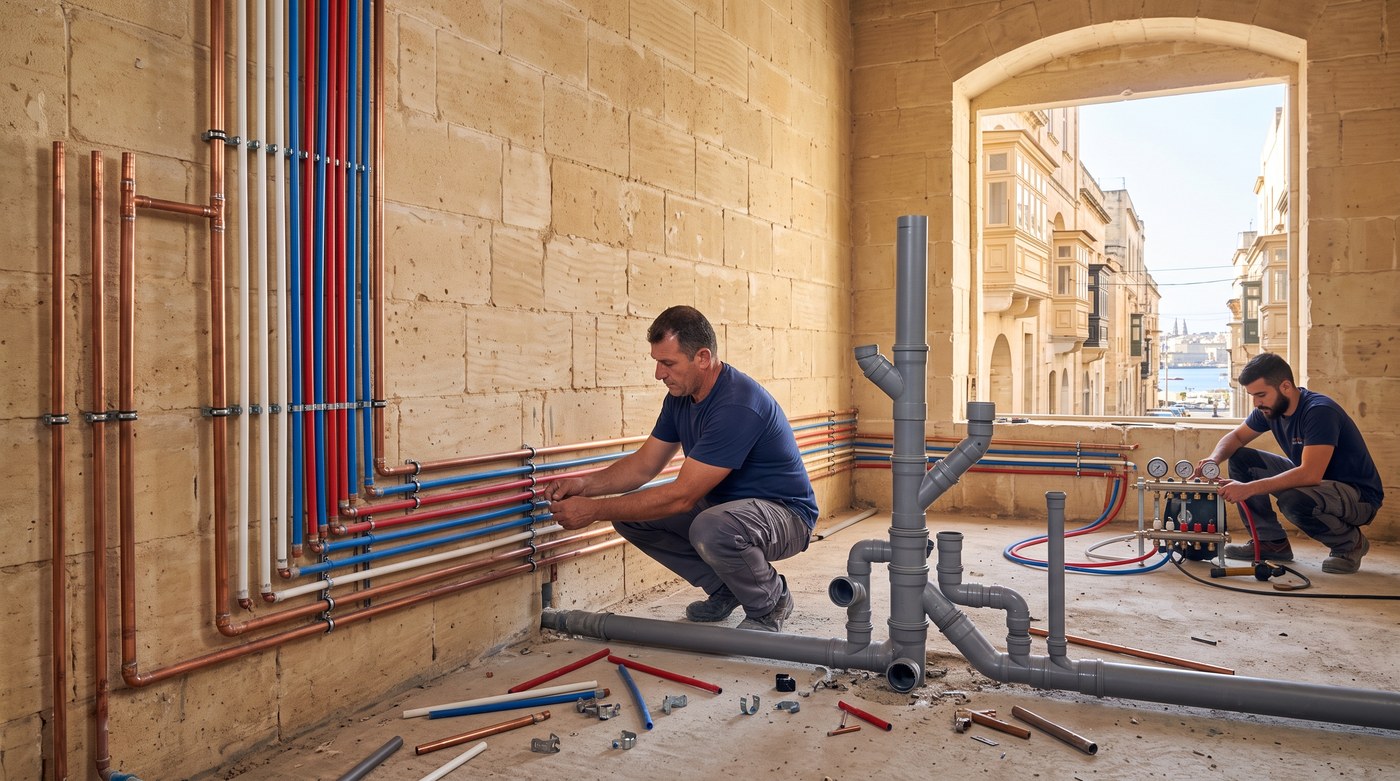
If you have moved here from the UK or elsewhere in the EU, the first instinct when hiring a plumber is to check a register — Gas Safe, a trade body, a licence number. In Malta that instinct has nowhere to go. There is no plumber's licence, and there is no public list you can search. That is not a gap in this article; it is the actual state of affairs, and knowing it changes how you should hire.
The contrast with electricians is the clearest proof
The simplest demonstration is ARMS Form A, the application for new electricity and water services. For a new electricity service, the form requires a declaration plus a copy of the licence or warrant of a licensed electrician or electrical engineer. The water section of the very same form asks for no plumber declaration and no plumber licence at all.
So the state does insist on a named, licensed professional before it will energise your supply — and does not do the equivalent for water. Whatever else you take from this article, take that: nobody is checking the plumber on your behalf.
What does exist: the Jobsplus Award as Plumber
There is a real qualification, even if there is no licence.
Jobsplus runs an Award as Plumber pegged at MQF/EQF Level 3, endorsed by the MFHEA. The handbook sets out how it works:
- Candidates normally need three years' experience under S.L. 607.02 of 2012.
- Applicants coming through the BICC skill-card route are exempt from the employment-history requirement.
- Assessment is by practical work, oral and written tests, and a portfolio interview — not a paper exercise.
- An unsuccessful candidate can appeal within 10 working days.
The competences assessed are worth reading as a homeowner, because they tell you what the trade is expected to handle here: isolating the domestic supply, mains and tank-fed cold water as distinct systems, hot water, drainage, WC, taps and tanks. The fact that the syllabus treats tank-fed cold water as its own competence alongside mains is a fair indication that roof tanks are normal rather than exotic — and that a plumber trained on a UK mains-pressure assumption is not automatically working on the same mental model as the one standing in your airspace.
This is a qualification, not a licence. Holding it is not a legal precondition to doing the work, and not holding it is not an offence.
The Construction Industry Skill Card
The second thing that exists is the Construction Industry Skill Card. CEDEFOP records it as introduced in 2015, managed by the BICC under a Ministerial Order, with five levels — apprentice, operator, craftsman, technician and professional — requiring a health and safety course plus a competence assessment, valid for five years, and voluntary as of December 2020.
MaltaToday reported the launch on 23 May 2016, covering plasterers, tile layers, assistant electricians and plumbers as the first trades. To get a card, a worker needed a certificate of competence (or an ETC trade test) plus an eight-hour OHSA health and safety course. Trainees got a red card. The plan at the time was to add 110 further trades over five years.
The regulations are still not finished. In a circular dated 20 July 2026, the Kamra tal-Periti recorded that on 24 March 2026 the BCA had told periti a skill card would be legally required to enter a site from January 2027 — and stated plainly that no such requirement exists, because the skill-card regulations are still being finalised and are not in force. If a professional body has to issue a circular telling its own members that an announced rule is not law, you can see why a homeowner has nothing firm to check against.
So what do you actually check?
Since there is no register, you are reduced to asking directly and looking at the document:
- Ask whether the plumber holds the Award as Plumber at MQF Level 3, and ask to see the certificate.
- Ask whether anyone attending holds a Construction Industry Skill Card, and at which of the five levels.
- Accept that neither is legally required, so a "no" is not disqualifying — but an evasive answer about a certificate that is supposedly held is.
- Verify what you can verify by other means: a trading name, a VAT number on the quote, a written address, and a quote that survives comparison with a second one.
The brief is where your protection actually sits
With no licensing body behind you, the written quote is the document that does the work. The guidance here is consistent and unglamorous:
- Get an itemised quote that shows call-out, labour, parts and VAT as separate lines.
- Refuse one-line quotes. "Bathroom works — €X" tells you nothing and cannot be disputed later.
- Do not let work start without written confirmation. Verbal agreement plus a man already in the wall is a bad negotiating position.
- Ask what warranty covers the work, and get it in writing with the quote.
- Compare at least two providers before you commit.
Four Malta-specific lines are worth adding to any brief:
- Shell form. If you have bought in shell, there is no existing installation to work from, so the quote should state what is being run, where, and to what points — not "first fix".
- Condominium. In an apartment, works touching common parts, risers, the roof or shared tanks are bound by the condominium's rules. Establish who has to approve what before anybody books a date.
- Gozo. Every delivery crosses on the ferry. Ask explicitly whether materials transport and travel are in the price or billed separately, and which line of the quote they appear on.
- Tanks and geysers. If the job touches roof tanks or hot water, say so in the brief, because the syllabus treats those as distinct competences and so should your quote.
Prices change, and any published figure is indicative — the guide used here was last updated on 20/02/2026 and says as much about its own numbers.
If the job goes wrong
Malta's consumer-protection authority, the MCCAA, is the body homeowners are generally pointed towards for a dispute with a trader. None of the sources used for this article sets out its procedure, its time limits, or what it can require a trader to do, so this is a pointer rather than a guide — check the authority's own published process before relying on it.
What matters more, practically, is what you can hand over when you complain. An itemised written quote, a written warranty and an invoice that matches the quote make a complaint legible to anyone. A verbal agreement and a round-number cash figure make it nearly impossible to pursue. In the absence of a licence that can be suspended, the paperwork is the enforcement mechanism.
Common questions
- Do plumbers in Malta need a licence?
- No. There is no plumber's licence in Malta. Compare this with electricity: ARMS Form A, the application for new services, requires a declaration and a copy of the licence or warrant of a licensed electrician or electrical engineer before an electricity supply is connected. The water section of the same form asks for no equivalent plumber declaration or licence.
- Can I look a plumber up on a public register?
- No. None of the bodies involved — Jobsplus, the BICC or the BCA — publishes a searchable list of plumbers you can check a name against. If you want evidence of qualification, you have to ask the plumber for the certificate itself and look at it.
- What qualification can a Maltese plumber actually hold?
- The Award as Plumber, pegged at MQF/EQF Level 3 and endorsed by the MFHEA. Candidates normally need three years' experience under S.L. 607.02 of 2012, and are assessed by practical work, oral and written tests and a portfolio interview. Applicants coming through the BICC skill-card route are exempt from the employment-history requirement.
- Is the Construction Industry Skill Card compulsory?
- Not as things stand. CEDEFOP recorded the card as voluntary as of December 2020. In a circular dated 20 July 2026, the Kamra tal-Periti noted that the BCA had told periti on 24 March 2026 that a card would be legally required to enter a site from January 2027, and stated that no such requirement exists because the skill-card regulations are still being finalised and not in force.
- What should a plumbing quote include?
- An itemised written quote showing the call-out charge, labour, parts and VAT separately, plus the warranty on the work. Avoid one-line quotes and avoid letting work start without written confirmation. Compare at least two providers before you commit.
What we could not establish
- No public register of plumbers exists in Malta, and no source establishes how many plumbers hold the Jobsplus Award as Plumber or a Construction Industry Skill Card.
- The sources used here do not set out the MCCAA's complaint procedure, its time limits, or what it can order a trader to do — so this article cannot describe that route in detail.
- Nothing published tells you whether the skill-card regulations have been brought into force since the Kamra tal-Periti's July 2026 circular, or whether the January 2027 site-entry date held.
- No source establishes whether plumbers in Malta are required to carry public liability or professional indemnity insurance, or what is normal in practice.
- No source establishes a standard or minimum warranty period for plumbing work in Malta.
- The 110 further trades MaltaToday reported were planned for the skill card over five years are not listed anywhere in these sources, and no progress update is published.
Sources
- Plumber – MQF/EQF Level 3 Information Handbook — Jobsplus · read 2026-10-05
- Skill cards for construction workers launched — MaltaToday · read 2026-10-05
- Construction Industry Skill Card – Matching skills instrument (Malta) — CEDEFOP · read 2026-09-21
- CIR 04/26 – Construction Industry Skill Card — Kamra tal-Periti · read 2026-10-05
- ARMS Form A – Application for new electricity and water services (version 11/2025) — ARMS Ltd · read 2026-10-05
- Plumber Cost in Malta: 2026 Pricing Guide — Malta Service Hub · read 2026-10-05
Drafted with Claude — claude-opus-5, then read, corrected and approved by Neil Bennett before publication. We do not publish anything a person has not read.
Want this costed properly?
The calculator gives you a figure in a minute. A site visit gives you a fixed price.
Book a free survey