
Hard water in Malta: softeners, RO and costs
Malta's mains water scales geysers, kettles and mixer cartridges. Three products get sold against it — drinking-water RO, whole-house pre-filtration and a softener — and they solve three different problems at three very different prices.
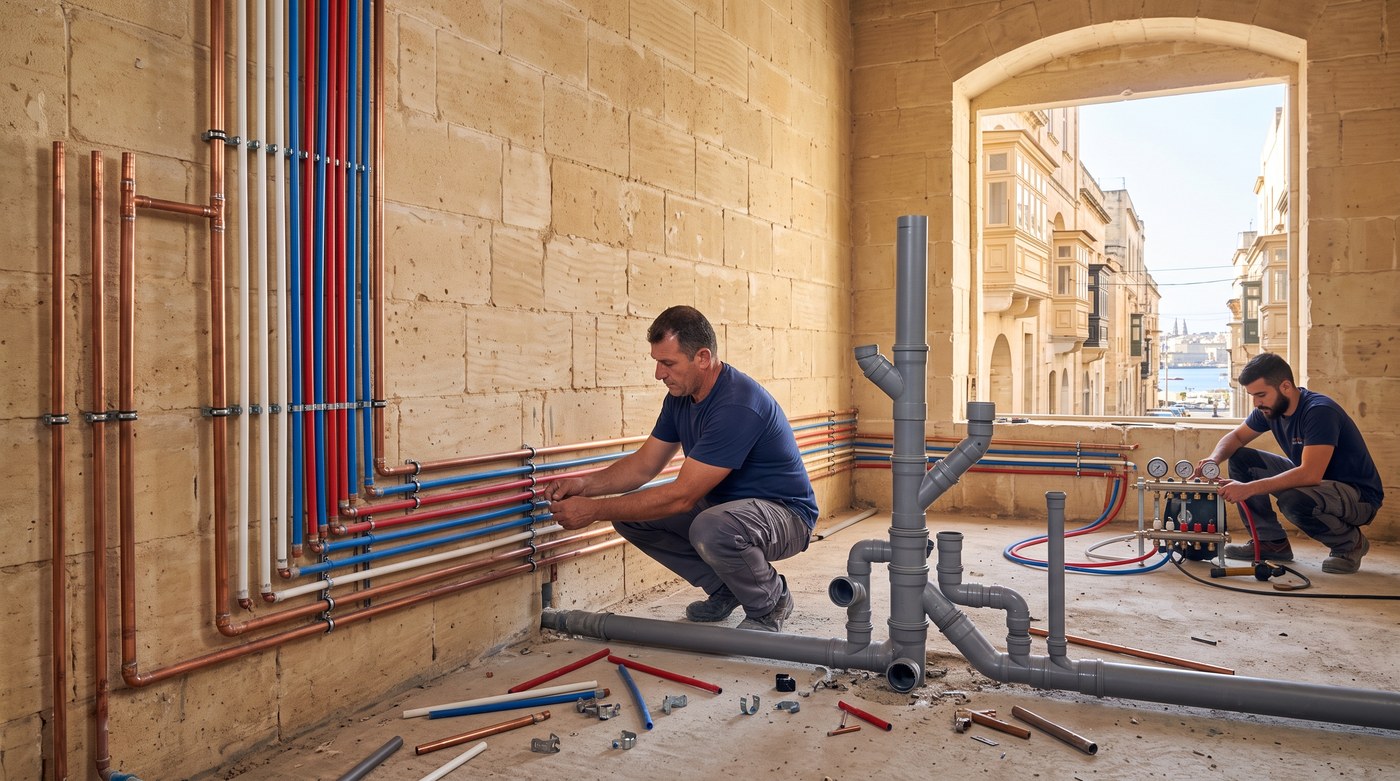
If you have arrived from the UK, your mental model of water treatment is probably a scale-reducing cartridge on a combi boiler and a filter jug on the worktop. Malta rearranges the problem. Water reaches most properties at low mains pressure, sits in a roof tank, and is heated by an electric geyser with an immersion element in it. Hard water scaling attacks that element and shortens the geyser's working life, which is one of the standard reasons a geyser ends up being replaced rather than repaired. The same water leaves crust on kettles, shower screens and mixer cartridges.
Three products get sold against this, and they are not interchangeable.
The three options and what they cost
| System | Published price | Where it sits | What it is for |
|---|---|---|---|
| Reverse osmosis (RO) package, installed with a year's service | from EUR 455 | Point of use, usually under the kitchen sink | Drinking and cooking water |
| RO unit alone (no installation, no service) | EUR 310 | Same | Drinking and cooking water |
| Whole-house pre-filtration | EUR 260–385 | On the incoming supply | Sediment and particulates before the rest of the system |
| Water softener | EUR 900–1,060 | On the incoming supply | Scale in pipework, geyser and fittings |
| Softener salt | EUR 29.50 per 25 kg | Consumable | Regenerating the softener resin |
Those are the catalogue figures. Note what the RO pricing is telling you: the difference between EUR 310 and EUR 455 is installation plus a year's service. If you are handy and your kitchen already has a tap hole, the unit-only price is a real option. If you are not, buying the unit alone and then finding someone to fit it rarely saves the gap.
Drinking-water RO: the narrow, cheap fix
An RO system treats the water at one tap. It does nothing for the shower, the washing machine, the geyser or the mixer cartridges. What it gives you is drinking and cooking water at a fixed capital cost of EUR 310 for the unit, or from EUR 455 for the installed package with a year's service included.
For most tenants, and for a lot of owners in flats, this is the whole of the sensible answer. It is reversible, it does not touch the common parts of the building, and it is the only one of the three that you could plausibly take with you.
The running cost is membranes and cartridges. These are sold as separate items and they are consumables, not optional. The first year is covered in the EUR 455 package; after that you are buying replacements on a schedule. We are not going to quote you a figure for those, because the sources we have do not fix one — see the gaps list. Ask for the replacement schedule and the per-item price in writing before you buy, and treat a supplier who will not give it as an answer in itself.
Whole-house pre-filtration: the one that is most often misunderstood
At EUR 260–385, pre-filtration is the cheapest whole-house intervention, and it is routinely bought for the wrong reason. It is a filter for particulates on the incoming supply. It is not a softener, it is not a drinking-water treatment, and buying it will not stop scale forming in your geyser.
Where it earns its money is protecting everything downstream of it — including a softener or an RO, if you have one — from sediment. In a property with a roof tank, that matters more than it does in the UK, because a tank is an open-ish reservoir with dust, grit and whatever else finds its way in. Plumbers here offer roof-tank cleaning as a distinct service alongside filtration, softeners and RO, which tells you the tank is a recognised part of the problem rather than a neutral vessel.
Softeners: the expensive one, and the only one that protects the geyser
A softener is EUR 900–1,060 plus salt at EUR 29.50 per 25 kg. It treats the whole incoming supply, which is why it is the only one of the three that addresses scale reaching the geyser element, the pipework and the fittings.
Three honest constraints before you commit:
- It is a consumable-driven appliance. The salt price is published; annual consumption is not. Nobody in these sources publishes how many bags a Maltese household gets through in a year, so you cannot convert EUR 29.50 into an annual figure without your supplier telling you the regeneration rate for your unit and household size.
- It needs somewhere to live, with a drain. In a terraced house or a townhouse this is usually solvable. In an apartment where the incoming supply and the roof tank are in common parts, the installation touches areas the condominium controls, and that is a conversation to have before you buy the unit, not after.
- No source quantifies the payback. The link between hard water scaling and shortened geyser life is documented. The number of extra years a softener adds is not. If someone tells you it pays for itself in a specific number of years, ask where that number comes from.
Buying at shell stage
Most property here is sold in shell form, which is the one genuine advantage a buyer in Malta has over a buyer in the UK. At shell stage the incoming supply, the roof tank feed and the drain are all still accessible, and deciding whether there will ever be a softener is a five-minute decision rather than a chase-the-walls job. Even if you do not buy the unit now, leaving a serviceable position with a drain nearby on the incoming main costs almost nothing and removes the main obstacle later.
The same applies to the kitchen. An RO needs an under-sink position, a drain connection and, usually, a dedicated tap hole in the worktop. Worktops get templated and cut once.
Gozo
Every one of these systems is a delivered item, and delivery to Gozo means the ferry. None of the sources publishes a Gozo surcharge for water systems, so assume delivery and call-out are quoted separately and ask up front — particularly for a softener, which is heavy and bulky, and for the salt, which is a repeating 25 kg delivery rather than a one-off.
Checking who fits it
Malta has no plumber's licence in the sense a British reader expects: none of the sources here identifies a register you can look someone up on. Filtration, softeners, RO and roof-tank cleaning are all offered by plumbers in the general market, which means the trade is competent but unregulated, and the checking is on you. Third-party verification schemes are the substitute. Ask what the year's service in an RO package actually covers, get the replacement cartridge schedule in writing, and for a softener get the expected salt consumption from the supplier in bags per year, not in vague terms.
Common questions
- Will a water softener stop my geyser scaling up?
- A softener treats the whole incoming supply, so it is the only one of the three products that addresses scale reaching the geyser element. Hard water scaling shortens geyser life, which is why the question matters. What no source we have publishes is how many extra years a softener buys you, so treat any specific promise on that with suspicion.
- If I fit a softener, do I still need reverse osmosis for drinking water?
- They are separate jobs. A softener is a whole-house appliance aimed at scale in pipework, the geyser and fittings. Reverse osmosis is a point-of-use drinking-water system, typically under the kitchen sink. Fitting one does not remove the reason for the other, and the two are sold and priced separately.
- How much does softener salt cost in Malta?
- Salt is listed at EUR 29.50 per 25 kg bag. How many bags a household gets through in a year is not published anywhere in the sources we have, so the honest answer is that the per-bag price is known and the annual total is not.
- What is the cheapest way to get drinkable water at the kitchen tap?
- The lowest published entry point is a reverse osmosis unit on its own at EUR 310, with an installed package including a year's service from EUR 455. Whole-house pre-filtration at EUR 260–385 is not a drinking-water treatment and should not be bought as a substitute for one.
What we could not establish
- Nobody in these sources publishes an actual hardness figure for Malta's mains water — no mg/l of calcium carbonate, no °dH, and no breakdown by locality or by whether the supply is desalinated or groundwater.
- Replacement RO membrane and cartridge prices, and the intervals at which they are due, are not pinned to specific figures we can reproduce, so the annual running cost of an RO after the first year cannot be stated.
- Average household salt consumption is not published, so EUR 29.50 per 25 kg cannot be turned into an annual softener running cost.
- No source quantifies how much longer a geyser lasts if the supply is softened.
- Nothing here establishes how much water an RO sends to drain, so the effect on an ARMS water bill is unknown.
- No source addresses condominium consent for installing a softener in a shared shaft or on a common roof, or whether the Water Services Corporation requires any notification.
- Gozo delivery or call-out surcharges for these systems are not published anywhere in these sources.
- None of these sources identifies a licensing body for plumbers or water-treatment installers in Malta, so there is no register a buyer can check an installer against.
Sources
- Bridgepoint Malta – Water Systems catalogue — Bridgepoint Malta · read 2026-09-21
- Water Heater (Geyser) Problems in Malta: Repair or Replace? — Qabbad · read 2026-09-21
- Top 5 Malta plumbers who'll fix leaks and clogs fast [2026] — thebestmalta.com · read 2026-09-21
Want this costed properly?
The calculator gives you a figure in a minute. A site visit gives you a fixed price.
Book a free survey