
Getting a WSC water meter in a new apartment
A walk through the ARMS Form A application for a new water service in Malta and Gozo — the compliance certificate, the photos, the fees, who decides where the meter goes, and why the number of registered occupants changes what you pay per cubic metre.
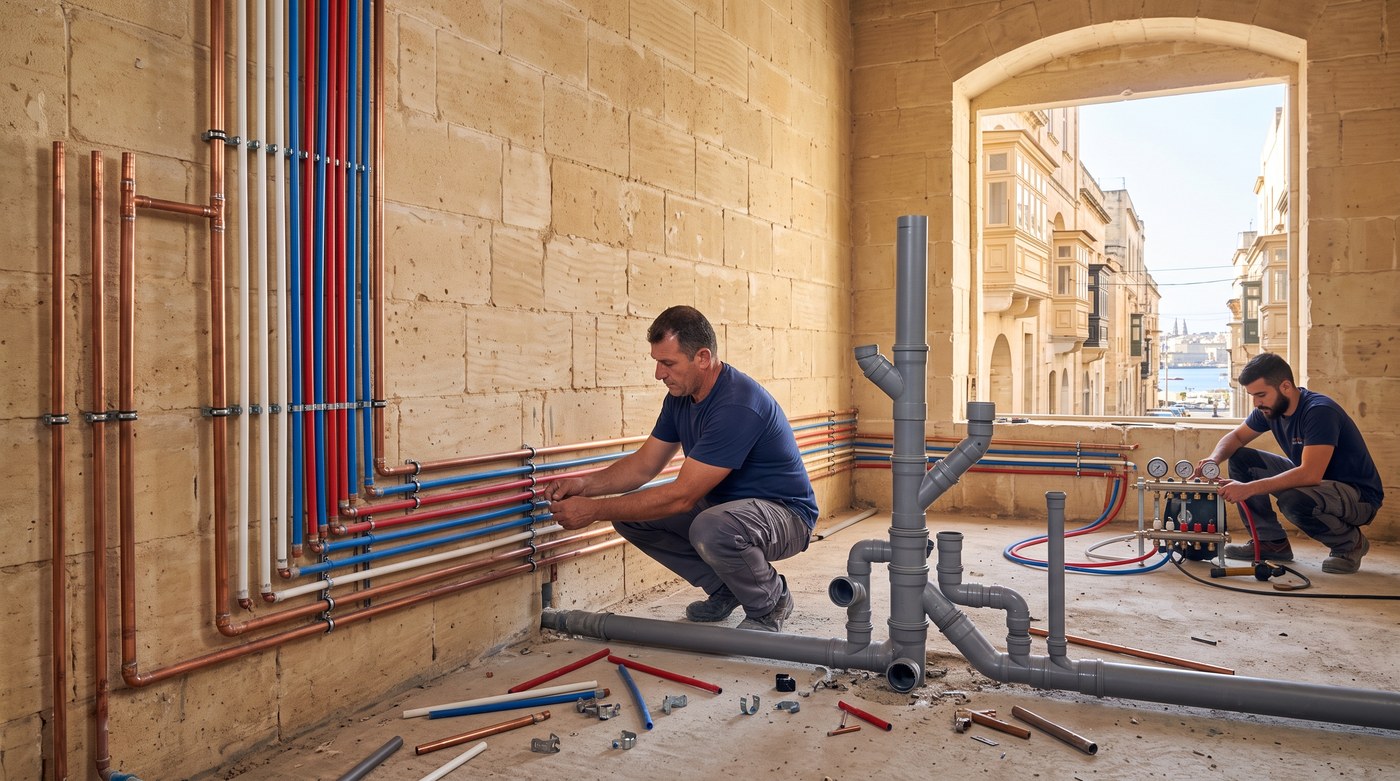
If you have just bought a new apartment in Malta or Gozo, the water meter is not something the developer necessarily hands you along with the keys. Property here is commonly sold in shell form, and a shell has no service connection. Getting water means an application, a fee, a set of documents and a wait — and the body you apply to is not the Water Services Corporation directly. It is ARMS Ltd, using Form A – Application for new electricity and water services, the same form that covers the electricity supply.
This matters if you have arrived from the UK, where you would simply ring a water company and give them a meter reading. There is no water company to ring. ARMS handles the application and the billing relationship; WSC owns and operates the network and decides the physical work; and REWS is the regulator sitting above both.
Before you apply: the compliance certificate
Form A ties the new connection to planning compliance. The application asks for the Planning Authority compliance certificate number, and the connection is conditional on it. WSC separately states that the property must be within the development zone.
In practice this is the item that stalls applications. If the building has not been certified as compliant with its permit, there is no number to put on the form, and no amount of chasing ARMS will produce a meter. That is a question for the developer or the architect who followed the works, not for a plumber.
WSC also states that there must be no outstanding dues in connection with the property. An old debt attached to the address is a live obstacle to a new service.
What Form A asks for
Alongside the compliance certificate number, the application requires:
- a site plan showing the property;
- identification for the applicant;
- a photograph of the façade of the building;
- a photograph of the proposed meter position.
The photographs are not a formality. They are how the Corporation assesses where a meter and its RF module can physically go without a site visit first.
The fees
Reproduced exactly as published by REWS and on Form A:
| Item | Amount |
|---|---|
| New water connection, residential | EUR 345 |
| New water connection, non-residential | EUR 760 |
| Each metre beyond the first 7 m | EUR 23.29 |
| Deposit, where the applicant is a tenant | EUR 500 |
The per-metre charge is the one people do not budget for. Seven metres is the allowance; if the distance from the main to the agreed meter position is longer, the excess is charged at EUR 23.29 per metre. On an apartment in a terraced street this rarely bites. On a standalone property set back from the road it can.
The EUR 500 deposit applies where the person applying is a tenant rather than the owner. Landlords letting a shell or a newly finished unit should decide early whose name the service goes into, because that decision changes both the deposit and who is on the hook for the bill.
WSC decides where the meter goes
Form A is explicit: the location of the meter and of the RF module is determined by the Corporation. You propose a position and photograph it; WSC makes the call.
In an apartment block this intersects with the condominium. Meters are typically grouped in a common part of the building, and common parts are governed by the condominium rules, not by any single owner. If you were imagining a neat meter box inside your own front door because that is how it worked at home, set that expectation aside. Plan your internal pipework from wherever the Corporation puts the meter, not from where you would prefer it.
One connection per building
REWS states the rule plainly: a single service connection serves a building, including where buildings are interconnected. You do not get a fresh connection from the main for each apartment or each subdivided unit. This is why, in a block, the argument is usually about sub-metering and internal distribution rather than about multiplying connections — and why a developer who has already taken the building's connection has, in effect, made that decision for everyone in it.
How long it takes
WSC gives one month as the installation target once the application is in order. "In order" is doing the work in that sentence: compliance certificate present, no outstanding dues, documents complete, fee paid. An application missing the certificate number is not a one-month application, it is an application that has not really started.
Then the bills: why occupants matter more than you think
The WSC residential tariff is not a flat rate per cubic metre. It is banded, and the bands are allocated per person per year in blocks of 33 m³:
| Annual consumption band | Rate per m³ |
|---|---|
| First 33 m³ per person | EUR 1.3965 |
| Next 33 m³ per person | EUR 2.1850 |
| Above that | EUR 5.1395 |
The top rate is roughly three and a half times the bottom one, and the jump is not gradual — you fall off the second band into the third. The practical consequence is that the number of registered occupants changes your bill even if your consumption does not. A household of four registered as a household of one has three-quarters of its cheap allowance missing, and the overflow is charged at EUR 2.1850 and then EUR 5.1395 per m³.
Two situations produce this quietly. The first is a family moving in over several months and never updating the registration after the first person took the service. The second is a let where the account stayed in the landlord's name from a period when nobody lived there.
Hard water makes the second and third bands easier to reach than new arrivals expect. Scale-related waste — a dribbling cistern, a washing machine filling and refilling, a geyser element working around a scaled tank — is consumption that shows on the meter regardless of whether you meant to use it.
Leaks after the meter are yours
WSC states that the consumer is responsible for leaks on the internal installation. The Corporation's responsibility stops at the connection; everything on your side of the meter is your problem, and it is metered. In a block, a leak in a riser or on a roof-tank feed can run for weeks unnoticed and will be billed at whichever band it pushes you into.
If it goes wrong
The Water Supply Regulations govern the supply, and REWS publishes the dispute route: raise the complaint with the Corporation first, and escalate to the regulator if it is not resolved. That is the mechanism. It is worth knowing it exists before you need it, because there is no ombudsman-by-another-name to ring instead.
Common questions
- Can I choose where the water meter goes?
- No. ARMS Form A states that the location of the meter and of the RF module is determined by the Corporation, not by the applicant or the developer. You supply photographs of the façade and of the proposed meter position, but the final decision is not yours.
- How much does a new residential water connection cost?
- EUR 345 for a residential connection and EUR 760 for a non-residential one, as published by REWS and on ARMS Form A. Beyond the first 7 metres, an additional EUR 23.29 per metre applies. Applicants who are tenants rather than owners also pay a EUR 500 deposit.
- Why does registering the number of occupants matter?
- The WSC residential tariff is banded per person per year in blocks of 33 m³. With more registered occupants, more of your consumption falls in the cheapest band at EUR 1.3965 per m³ instead of spilling into EUR 2.1850 and then EUR 5.1395 per m³.
- My block has several apartments — does each one get its own connection?
- REWS states the rule as one connection per building. Where a building is interconnected, a single service connection covers it, and individual apartments are then metered off that arrangement rather than each drawing a separate connection from the main.
What we could not establish
- The sources do not say whether the EUR 500 tenant deposit is refundable, when, or under what conditions.
- Neither ARMS nor WSC publishes whether the fees quoted are inclusive or exclusive of VAT.
- The one-month installation target is stated by WSC but nothing in the sources says what happens if it is missed, or whether the clock starts at submission, at payment, or at approval of documents.
- No source sets out a different process, fee or timeline for Gozo, nor addresses ferry-related delays.
- Nothing in these sources describes the internal plumbing you must have ready — roof tank, pump, non-return valve, stop-cock position — or states a guaranteed mains pressure at the meter.
- How occupants are registered and what proof is accepted is not set out in the documents cited here.
- The sources do not state how a dispute between a condominium and WSC over the chosen meter position is resolved.
Sources
- ARMS Form A – Application for new electricity and water services (version 11/2025) — ARMS Ltd · read 2026-09-21
- Water – consumer information (REWS) — REWS · read 2026-09-21
- Important Information – Water Services Corporation — Water Services Corporation · read 2026-09-21
- Tariffs – Water Services Corporation — Water Services Corporation · read 2026-09-21
Want this costed properly?
The calculator gives you a figure in a minute. A site visit gives you a fixed price.
Book a free survey